

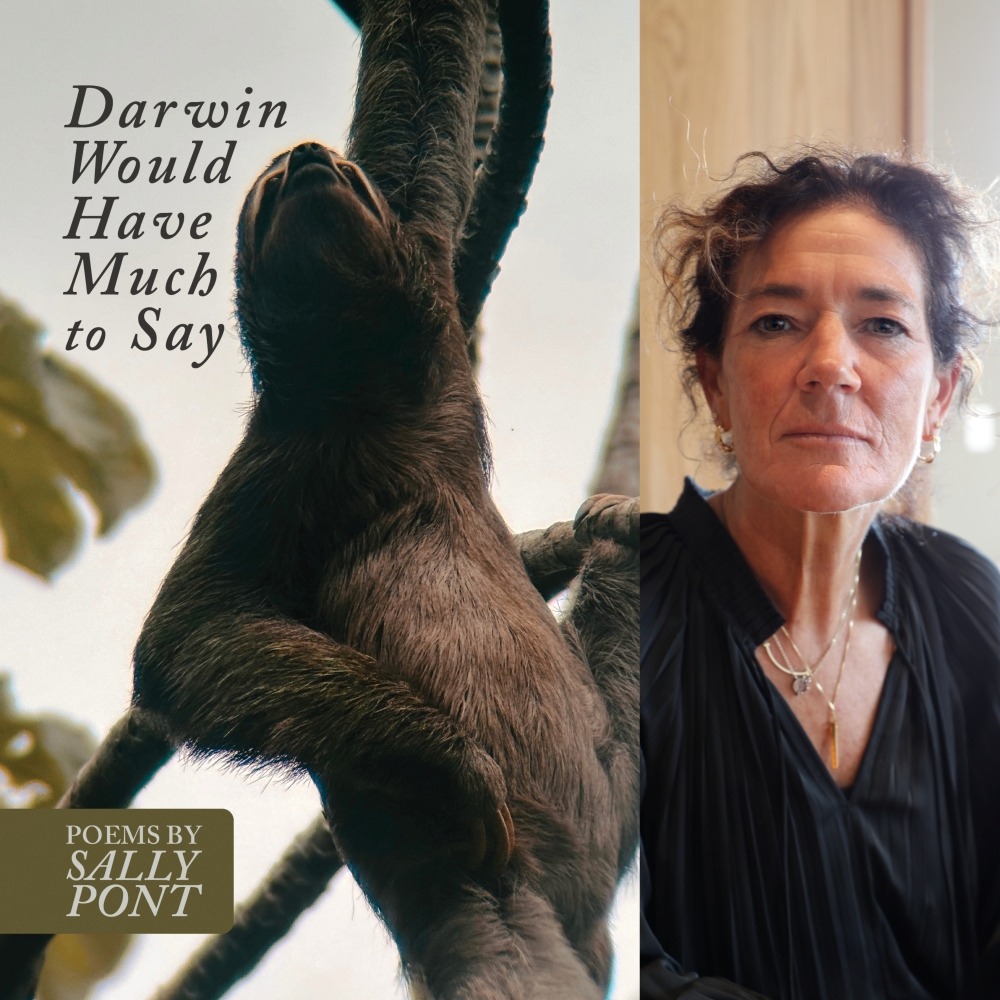
Sally Pont is a writer, educator, and long-distance runner who lives in Northern Virginia. A graduate of the University of North Carolina Chapel Hill and the MFA program at Penn State University, she has enjoyed a life-long liaison with language. Pont has published fiction in Conjunctions, Whiskey Island Magazine, The Normal School, Slab, and other journals. Though she has published two full works of nonfiction, Finding Their Stride and Fields of Honor, she feels that truth lies not in the fact but in the telling.
PRAISE:
Sally Pont’s impressive debut collection, Darwin Would Have Much to Say, reimagines our place in the natural world in a technology-driven age. Weaving together richly textured poems that explore the complex dynamics of predator, prey, and scavenger, Pont reveals how each of us, in our shifting roles, reflects the instinctive traits of nature’s archetypes. While she recognizes the necessity of survival, Pont carefully distinguishes human conflict from natural struggle, emphasizing our unique capacity for malice. “We, above ground, predator-free, / aspire to sky,” she writes, only to observe, “Struck by fear, we then tunnel / with canned goods and guns.” In seeking release from our most destructive impulses, Pont calls for a deeper alignment with Darwinian “grandeur,” proposing that the remedy for human cruelty lies in cooperation and altruism. “Why not,” she asks, “believe love elbows / past instinct to spur / sacrifice?”
–Robert Bernard Hass, Executive Director of the Robert Frost Society
In this reflective, raw and quietly brutal collection, nature is a mirror for human uncertainty and adaptation. At once intimate and abstract, Pont’s poetry uniquely combines the savage status quo and the elegance of evolution. Weaving instinct and sacrifice with existential existence, she goes beyond the performance of survival and into the internal, eternally pulsing game of waiting — game of living.
–Emily Dissanayake, Editor of El Vaquero and Dear Asian Youth Irvine
Those familiar with Sally Pont’s earlier paean to cross-country running, the memoir Finding Our Stride, will recognize the underpinning of these powerful poems, many of which focus on the weather and creatures that she encounters on the long, solo runs that still inform her life. In these unsentimental but lyrical poems, we must consider the mother possum hit by a car, the ravenous hunger of feral cats, baby mice eaten by hawks, and the grubs “teeming / in the moistness of new-growth pith” in the cycle of life and death. The narrator of Pont’s poems considers the pros and cons of hibernation and migration and whether or not to help a turtle “across this century of tar,” facing issues of individual identity and the moral choices that we all face. These are poems in a pastoral setting but with a powerful and breathtaking contemporary electricity.
The poems in this collection reflect a pastoral setting but with an electric and powerful contemporary sensibility that confronts us with the brutality of our days. They do so with a stunning combination of gentle concern and brutal confrontation with life and death in nature—observing both the “unblinking” eyes of ravenous feral cats and contemplating whether to help the turtle “across the century of tar” to the other side of the road. With reflections of Frost, Roethke, and Dillard, this collection will speak to nature lovers but also to admirers of Olds, Siken, and Vuong.
–Lisa Roney, author of Sweet Invisible Body, Serious Daring, and The Best Possible Bad Luck.
Reviews
There are no reviews yet.