

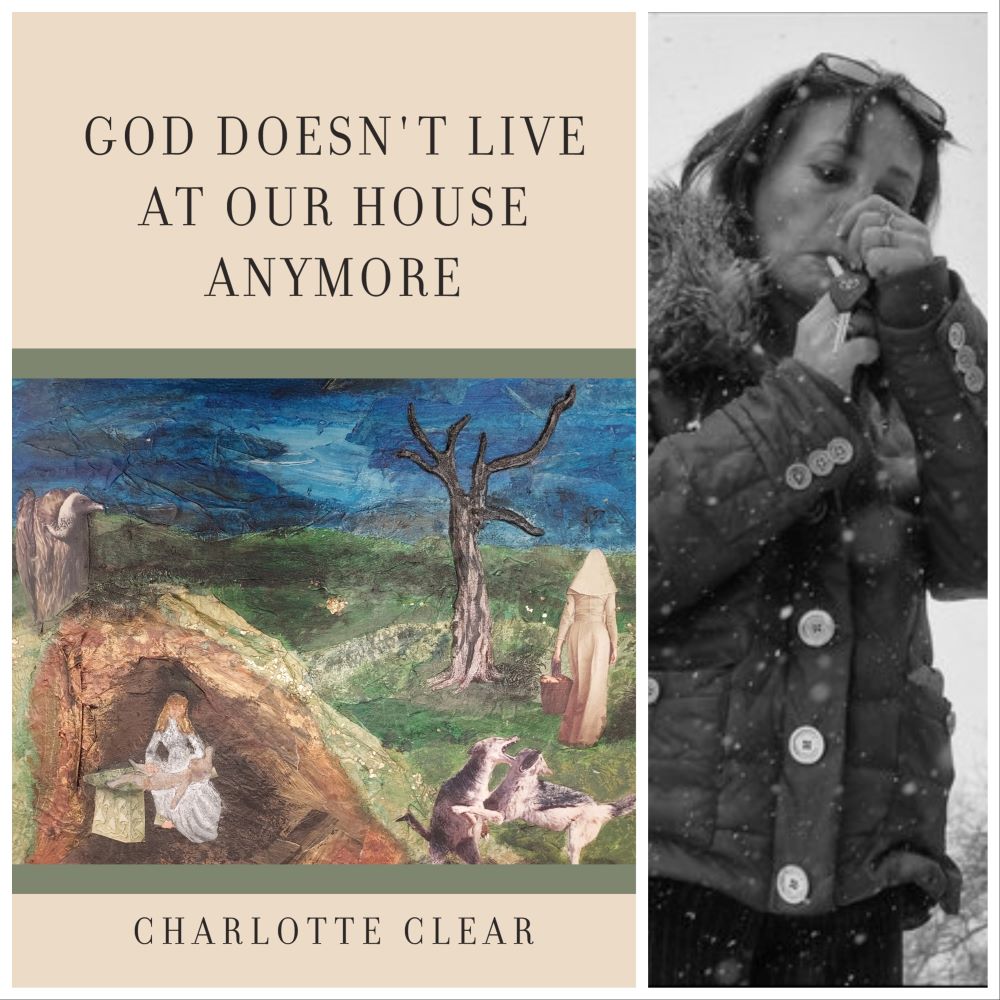
God Doesn’t Live at Our House Anymore
by Charlotte Clear
Paper
$17.99, paper
979-8-88838-423-7
2023
Charlotte Clear has written six poetry chapbooks and a novel All That Remains, which has been adapted as a play entitled “And She Was There.” Several of her short stories have been adapted as plays or published under another name. Her chapter “Powerless” was chosen and performed as the first Selected Short in N.J. by the N.J. Playwright Association, She has an M.F.A. and specializes in Poetry in Translation and bilingual poetry. For more information you can visit the following link to her website. https://goddoesntliveatourhouseanymore.wordpress.com/
Her novel is scheduled for publication in 2024 and her next chapbook “Savage” is scheduled for publication in 2023. All inquiries regarding Poetry readings or poetry classes that she teaches on line should be sent to the following email address: strategyofmemory@gmail.com
Rick Gilman –
These poems form a raw, unflinching portrait of domestic life, marriage, and the quiet ache of endurance. They speak in a voice that is both intimate and universal — a woman’s voice that refuses to be silenced by routine, exhaustion, or the slow erosion of love.
In “What Nobody Tells You,” the poet captures the dissonance between romance and reality with startling precision. The imagery — from dying hibiscus to the airless loft bed — transforms ordinary domestic scenes into metaphors for emotional distance. The poem’s rhythm mirrors the monotony of daily life, yet its honesty makes it luminous.
“Indentured Servitude” is a masterclass in emotional candor. It exposes the invisible labor of motherhood and marriage with a voice that is weary but never defeated. The poet’s restraint — her refusal to sentimentalize — gives the work its power. Each stanza feels like a confession whispered in the dark, a testament to survival through self-awareness.
Finally, “The Lottery” expands the collection’s scope, turning private disillusionment into social critique. Its imagery of stoning and public outrage evokes both shame and liberation, reminding us that desire and rebellion often coexist with guilt. The poem’s closing lines — stark, fearless, and tender — leave the reader suspended between ruin and revelation.
Together, these poems illuminate the tension between duty and desire, love and loneliness, confinement and awakening. They are brave, beautifully crafted, and deeply human — the kind of work that lingers long after the final line.