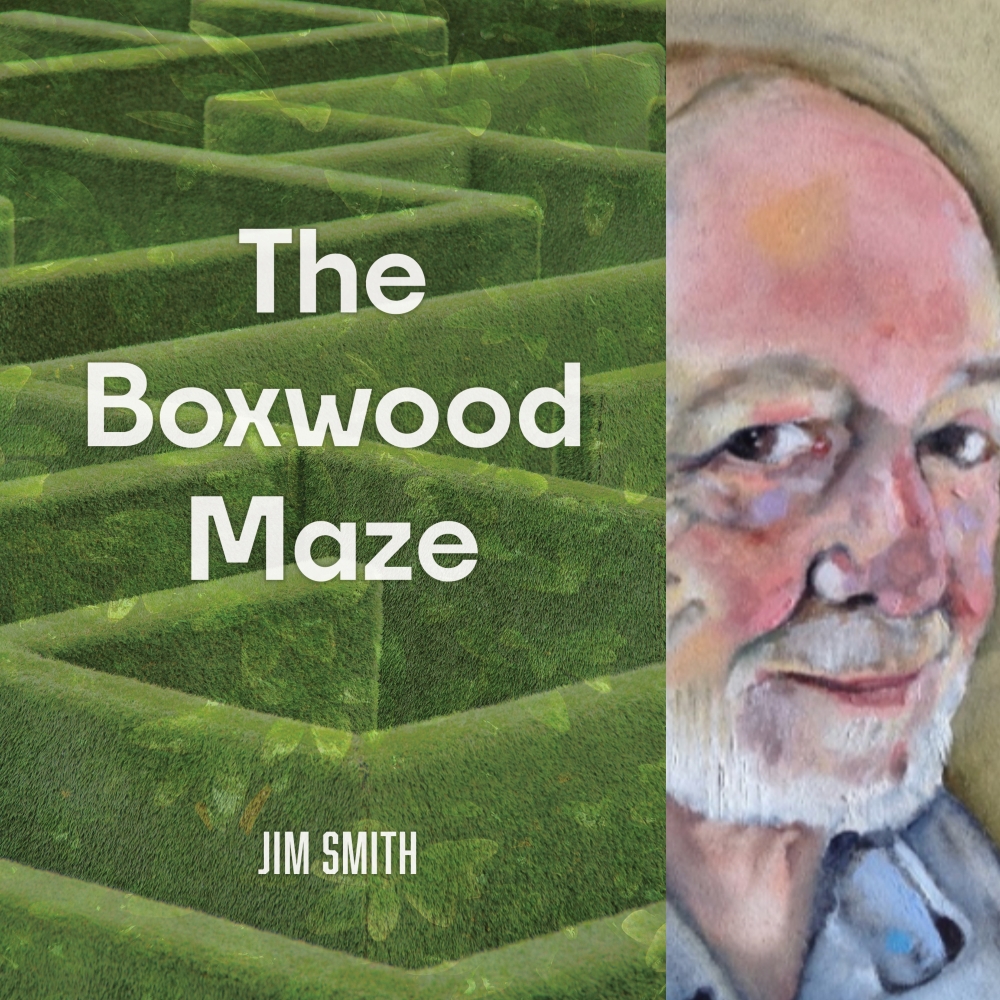
Somewhere between “Stay where you are,” the command that opens the book, and “Please file calmly out the door,” the instruction that closes it, Jim Smith’s triumphant debut, The Boxwood Maze, rolls out like a daydream one might have while waiting for the train doors to open, that instant between standing still and the initiation of a footstep. As much a poet of the comics as of the trauma scars of combat, Smith builds worlds of television spectacles and breakfast cereals, ice hotels and eclipses, presented not merely as experiments of the imagination, not merely for the awe and astonishment, though there’s that; as I read his poems I feel that I have touched down outside of time, given a day pass in the metaphor factory of the deep unconscious, where every poem is a box in which “You’ll go one way. I’ll go another. / Sometimes running into each other.” And “around a corner, the monster.” If ever there were a poet of the late night flick or the dime store kite, it would be the inimitable Jim Smith. He is one of my favorite writers.
–David Keplinger, author of Ice
What do we find inside Jim Smith’s The Boxwood Maze? A life long and richly lived, closely observed, and winningly captured in poetry. Widely allusive, the poems take us through history and memory; song, sadness, and celebration; heart-aches literal and figurative, “a cloud or some dragon [swallowing] the sun”; “a leaden night without a moon.” Too, Smith gives us strong measures of wry humor and hope played out in beautiful images and the occasional, artful foray into poetic form: pantoum, sonnet, ghazanelle. “The sun reappears from her devious eclipse; / wickedly laughing she parts the curtain of lace.”
–Moira Egan, author of The Furies
The Boxwood Maze – what an apt title for Jim Smith’s elegant debut poetry collection. Whimsical yet heartfelt, Smith’s voice is clear of eye and voice. Written in both free verse and form, his poems explore the wonders of being human in these challenging times. In his graceful opening poem, “The Boxwood Maze,” he traces a love relationship’s complicated course: Smith does not hesitate to treat cultural icons with irreverence. In “The Well,” Smith uses the metaphor of his little sister’s favorite TV show, Lassie, to illuminate sibling rivalry. Later poems interrogate Smith’s war veteran experience with authenticity and wisdom.
–Ellen Sazzman, author of The Shomer and Wild Irish Yenta





Reviews
There are no reviews yet.